rahim picks me up at 6:14 in the morning at a gas station outside Ouarzazate. He’s early, which I should have expected — he’s always early — and he’s drinking something that looks like tar from a thermos cup. “Coffee,” he says. “My wife’s recipe. Very strong. You want?” I take some out of politeness and instantly understand why he’s been up since four.
We’re headed for the Jebel Saghro range. Saghro, in Tamazight, means “drought” — which tells you everything you need to know about where we’re going. It’s the mountain nobody photographs, the one that sits between the tourist routes of the High Atlas and the tourist routes of the Sahara, getting skipped by every tour bus and nearly every 4×4 itinerary because the pistes are rough, the water is scarce, and there’s no “main attraction” to point at on a brochure.
That, of course, is exactly the point.
Day one: into the black stone
The road out of Ouarzazate runs south for an hour before it stops being a road. Brahim turns the Land Cruiser onto what I can only describe as a suggestion of a track — a thin pale line scratched across a dark rock plain. “This is the old caravan piste,” he says. “My grandfather brought dates this way.”
For the first two hours we don’t see another vehicle. Just the volcanic rock stretching out in every direction, black and pitted like something that cooled too fast. Occasionally a family of goats watches us from a ridge and then continues being unbothered. A shepherd in a faded blue jellaba waves once from about two hundred meters away; Brahim flashes the headlights in return.

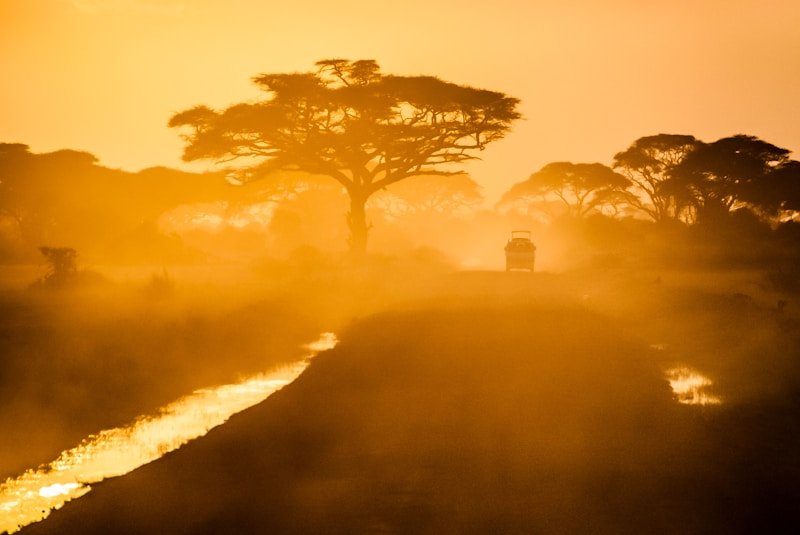
The piste out of Ouarzazate. Brahim says he’s driven this route more than 200 times.
“Morocco has an official Morocco,” Brahim says at one point, as we wait for a family of goats to finish crossing the track. “And then it has this.” He waves vaguely at the horizon.— Brahim, on Jebel Saghro
We reach the first village, Ikniouin, just before noon. Sixty-something houses carved into the hillside, all of them the same color as the rock they’re built from. Brahim is greeted by an older man at the edge of the village — they’ve known each other since Brahim was eight, when his father first brought him out here. There’s tea. There’s always tea. I learn in the first five minutes that you are supposed to accept three cups, minimum, and that rushing this is a mistake tourists make.
A note from the guide
If you’re visiting a village in rural Morocco, never accept just one cup of tea and leave. The first cup is bitter (“like life”), the second sweeter (“like love”), the third the sweetest (“like death”). It’s a whole thing — Berber hospitality has rules, and honoring them is how you stop being a tourist and start being a guest.
Day two: the village that isn’t supposed to exist
We wake up at the house of Brahim’s friend Hassan. His wife has made bread in the sand oven — literal sand, heated and then hollowed out — and it is somehow the best bread I have ever had. I say this out loud. Brahim translates. Hassan’s wife laughs and says something that makes Brahim laugh even harder.
“She said all the tourists say that, and it’s annoying because it’s just bread.”
After breakfast we head east. Today’s destination is Tagdilt, a village that doesn’t appear on most maps of Morocco and isn’t on Google at all. Brahim learned about it from his uncle, who learned about it from his uncle, and so on back through however many uncles you want. It’s built into the face of a cliff — not beside it, into it — with the caves as the back rooms of houses whose facades are plastered mud.
Things I did not expect in a village of 80 people:
- A school with four students and a teacher who commutes on donkey
- Solar panels on every roof, installed by a NGO program in 2019
- A 14-year-old boy named Idir who wanted to know if I’d heard of Ronaldinho
- The best orange I have eaten since I was a child — from a tree that the village has been tending for six generations
We spend the afternoon walking. Brahim points out the irrigation channels (“khettara” — underground, centuries old, still working). He shows me where the Amazigh inscriptions are scratched into a rock face nobody ever cleans. An old woman invites us in for lunch. It is, again, the best thing I have ever eaten.

Tagdilt village — built into the cliff face, population roughly 80, irrigated by 600-year-old underground channels.
Day three: coming out the other side
The last leg is the hardest drive. Brahim calls it “the washboard” — fifty kilometers of piste corrugated into parallel ridges by years of seasonal floods. We go slow. The Land Cruiser, which has crossed this route probably a hundred times, handles it the way a horse handles a trail it knows. Brahim drives with one hand on the wheel and one on the coffee thermos and tells me stories about his grandfather, who did the same route with a mule and two sons.
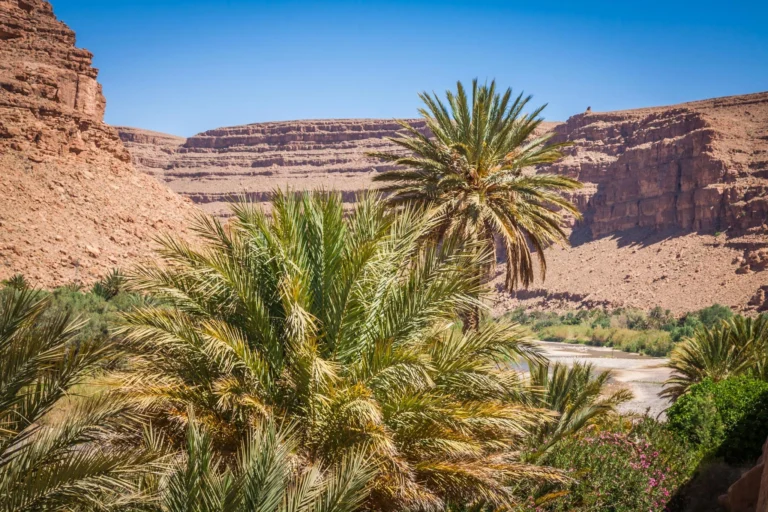
We come out of the mountains at Nekob, a palm-oasis town on the southern edge where the tarmac starts again. It feels wrong. After three days of hearing mostly wind and goats, the sound of an asphalt highway feels too loud, too organized. I say this to Brahim. He laughs. “Everyone says that. Then you get back to Marrakech and forget. But some people remember.”
If you want to do this
The Jebel Saghro crossing is one of our more adventurous routes. It’s not for a first Morocco trip — but if you’ve been before and want to see the country that isn’t on the postcard, this is as close as you get. A few practical notes:
- Vehicle: 4×4 only. No exceptions. The pistes are rough, the drops are real, and cell service is nonexistent for long stretches.
- Guide: You need someone who knows these villages. Without that, the whole experience is just driving over rocks. With it, the rocks are barely the point.
- Time of year: October–April. Summer is unpleasant. Winter nights are cold but clear, and the sunrise light on the black stone is the reason people cry at sunrises.
- Length: Three days minimum. Four is better. If you try to do it in two, you’ll miss the point.
If you want to do the Saghro crossing with us, it’s one of the standard routes on our Off-Road Adventures page. Brahim drives most of them personally. Tell him Youssef sent you and he’ll probably give you an extra cup of the tar coffee.